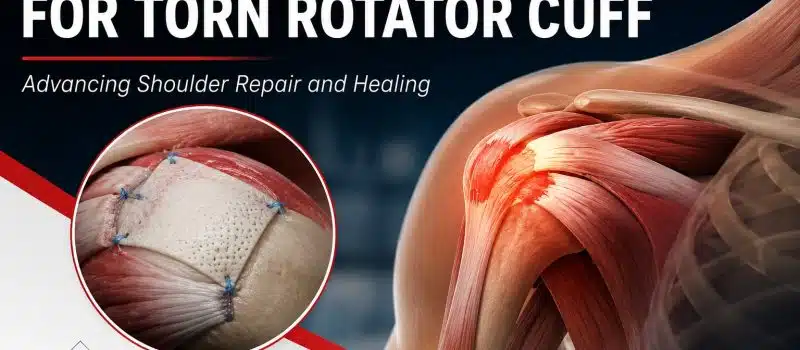
A torn rotator cuff can significantly impact daily life, making it difficult to lift objects, reach overhead, sleep comfortably, or participate in sports and recreational activities. While traditional rotator cuff repair surgery has helped countless patients regain function and reduce pain, advances in orthopedic technology have introduced new tools designed to improve healing outcomes. One of the most promising developments is the use of biologic patches during rotator cuff repair surgery.
Biologic patches are increasingly being used to reinforce damaged tendons, support tissue regeneration, and potentially improve the long-term success of rotator cuff repairs. For patients with larger tears, chronic injuries, or poor tissue quality, biologic augmentation may provide additional support where traditional repair techniques alone may not be sufficient.
Understanding Rotator Cuff Tears
The rotator cuff consists of four muscles and their associated tendons that stabilize the shoulder joint and allow smooth arm movement. Over time, age-related degeneration, repetitive overhead activities, sports injuries, and traumatic accidents can cause these tendons to become damaged or torn.
Rotator cuff tears can range from small partial-thickness injuries to massive full-thickness tears involving multiple tendons. Larger tears often present greater challenges because the tendon tissue may be weakened, retracted, or difficult to repair securely.
What Is a Biologic Patch?
A biologic patch is a specialized tissue graft designed to reinforce the repaired tendon and create an environment that supports natural healing. These patches are typically derived from processed human donor tissue, animal-derived collagen matrices, or other biologically compatible materials.
During surgery, the patch is placed over or integrated into the repaired tendon. It acts as a scaffold that encourages the body’s own healing cells to migrate into the area and promote tissue regeneration.
Unlike synthetic materials, biologic patches are designed to be incorporated into the body’s healing process over time.
Why Surgeons Use Biologic Patches
One of the biggest challenges in rotator cuff surgery is achieving complete tendon healing. Even when a repair is technically successful, some tendons may fail to fully heal because of poor blood supply, tissue degeneration, or excessive tension at the repair site.
Biologic patches may help by:
• Reinforcing weakened tendon tissue
• Reducing stress on the repair
• Supporting new tissue growth
• Enhancing biological healing
• Potentially lowering re-tear rates in selected patients
• Improving tendon thickness and strength during recovery
These benefits can be particularly valuable for larger or more complex rotator cuff tears.
Who May Benefit from Biologic Patch Augmentation?
Not every rotator cuff tear requires a biologic patch. Surgeons typically consider augmentation when patients have:
• Large or massive rotator cuff tears
• Chronic tears with poor tendon quality
• Revision rotator cuff surgery
• Significant tendon degeneration
• Increased risk of repair failure
• High functional demands or active lifestyles
Each patient’s anatomy, age, activity level, and tissue quality must be carefully evaluated before determining whether biologic augmentation is appropriate.
The Surgical Procedure
Biologic patch augmentation is often performed arthroscopically, using small incisions and specialized instruments. After the torn tendon is repaired to the bone, the surgeon secures the biologic patch over the repair site.
The patch acts as a protective reinforcement while the body’s natural healing process begins integrating new tissue into the repair.
Most patients undergo the procedure on an outpatient basis and return home the same day.
Recovery After Surgery
Recovery following biologic patch augmentation is generally similar to traditional rotator cuff repair recovery. Patients typically wear a sling during the initial healing phase and participate in a structured physical therapy program.Recovery milestones often include:
Early Phase
• Protection of the repair
• Pain and swelling management
• Gentle passive range-of-motion exercises
Interme